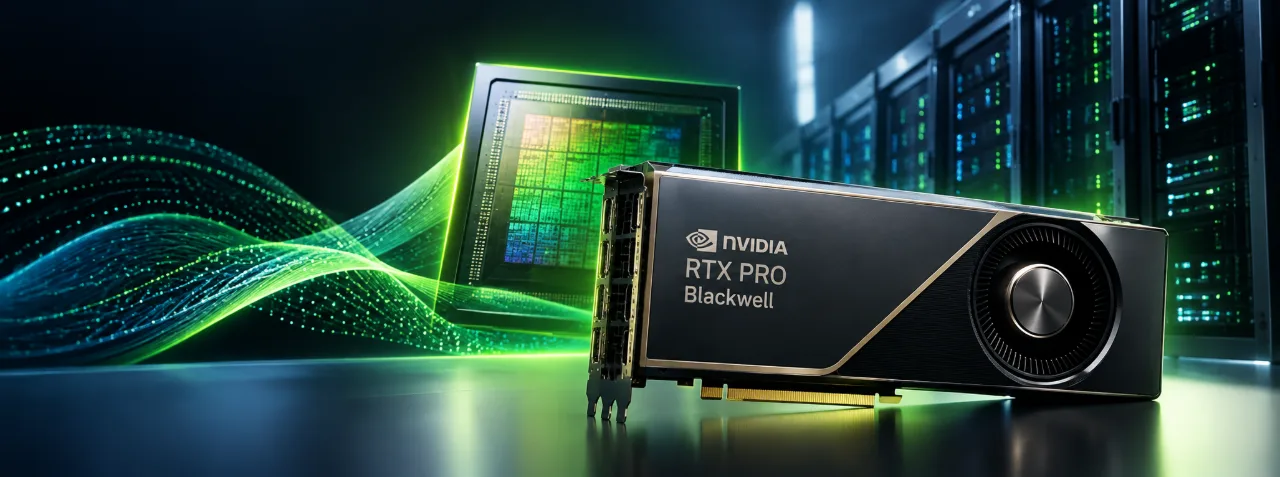
The NVIDIA RTX PRO 6000 Blackwell is the current flagship of NVIDIA's professional GPU line — 24,064 CUDA cores, 96 GB of GDDR7 ECC memory, 1,792 GB/s of bandwidth and up to 4,000 AI TOPS. It replaces the RTX 6000 Ada Generation, doubling both memory and bandwidth. In India, cards typically list between ₹13 lakh and ₹17 lakh, and hosted RTX PRO 6000 GPU servers rent from roughly ₹180 per hour.
If you searched for "NVIDIA RTX 6000" and landed here slightly confused about which card you were actually looking at, you are not alone. NVIDIA has shipped four different professional GPUs with "RTX 6000" in the name across four architectures. Getting that wrong is an expensive mistake — the gap between the oldest and newest is roughly 4× the memory and several times the AI throughput.
This guide sorts out the naming first, then covers what the current card does, what it costs in India, and whether it is worth buying at all versus renting one.
We operate GPU infrastructure from our own data centres in Noida and Mumbai, so the deployment and cost sections here come from running these cards, not from reading a datasheet.
First: Which "NVIDIA RTX 6000" Do You Actually Mean?
This trips up procurement teams constantly, because quotes and marketplace listings use the names interchangeably. Here is the full family in order.
| Card | Architecture | Launched | Memory | CUDA cores | |
|---|---|---|---|---|---|
| Quadro RTX 6000 | Turing | 2018 | 24 GB GDDR6 | 4 | |
| RTX A6000 | Ampere | 2020 | 48 GB GDDR6 ECC | 10 | |
| RTX 6000 Ada Generation | Ada Lovelace | 2022 | 48 GB GDDR6 ECC | 18 | |
| RTX PRO 6000 Blackwell | Blackwell | 2025 | 192 GB GDDR7 ECC | 24 |
Three practical notes:
- "RTX 6000" with no suffix almost always means the Ada Generation card in current listings, because that was the naming NVIDIA used from 2022 to 2025. It is not the Blackwell card.
- NVIDIA changed the branding in 2025 to "RTX PRO," which is why the newest card is the RTX PRO 6000 Blackwell rather than the "RTX 6000 Blackwell." You will still see it written both ways, and as RTX 6000 PRO Blackwell, which is the same thing.
- If a quote just says "RTX 6000 48GB," it is a previous-generation card. The Blackwell part is 96 GB. Memory capacity is the fastest way to tell them apart.
What Changed With Blackwell
The RTX PRO 6000 Blackwell was announced at NVIDIA GTC in March 2025. Compared to the RTX 6000 Ada it replaces, four things moved, and only two of them are the ones people talk about.
Memory doubled, and so did bandwidth. 48 GB of GDDR6 at 960 GB/s became 96 GB of GDDR7 at 1,792 GB/s, across a 512-bit bus instead of 384-bit. For AI inference this is the headline change, because token generation is memory-bandwidth-bound — every token generated requires reading model weights out of VRAM.
Tensor Cores gained native FP4. Fifth-generation Tensor Cores add NVFP4 support alongside FP8, BF16 and TF32. For quantised LLM serving, FP4 roughly doubles throughput over FP8 on compatible workloads. The "4,000 AI TOPS" figure NVIDIA quotes is an FP4 number — do not compare it against an older card's FP16 rating.
The media engines improved substantially. Four ninth-generation NVENC encoders and four sixth-generation NVDEC decoders, with 4:2:2 H.264 and HEVC support added. In Puget Systems' DaVinci Resolve testing, LongGOP media performance improved 43% over the RTX 6000 Ada and 114% over the RTX A6000 — a much larger jump than the overall average.
Power went up. The RTX 6000 Ada was a 300 W card. The Blackwell Workstation Edition runs at up to 600 W. This is the change that catches infrastructure teams out, and we will come back to it.
For context on realistic gains: Puget Systems measured an overall uplift of about 21% over the RTX 6000 Ada in DaVinci Resolve, with AI tests around 20% faster, but GPU Effects 78% faster. The pattern is consistent — where the workload leans on the new memory subsystem, RT cores or media engines, the gains are large. Where it does not, they are modest. Raw generational uplift alone rarely justifies the upgrade. Memory capacity usually does.
The Three Variants — Pick the Right One
All three carry the same 96 GB. They differ in power, cooling and where they physically belong.
Workstation Edition Max-Q Workstation Server Edition Max board power 600 W 300 W Configurable up to 600 W Cooling Active, double-flow-through Active, blower Passive — chassis airflow required Length 12 inches Dual slot 10.5 inches (fits 2U) Deploy in Single-GPU desktop tower Up to 4 GPUs per workstation Rack servers NVIDIA vGPU — — Supported Display outputs 4× DP 2.1b 4× DP 2.1b Present, disabled by default The Max-Q is the underrated option. It runs at half the power but, according to independent testing by AEC Magazine, delivers only around 12% lower performance across CUDA, AI and ray-tracing workloads. Four Max-Q cards give you 384 GB of VRAM at a combined 1,200 W. Four full-power cards need 2,400 W — which is more than many Indian office buildings can deliver to a single desk, let alone cool.
The Server Edition is the data centre part. It has no fan at all and depends entirely on chassis airflow, which is why it must go in a validated server. Some OEMs cap it below its ceiling for thermal headroom — Lenovo, for instance, lists a ThinkSystem configuration slot-capped at 450 W.
Where it sits in the wider RTX PRO Blackwell family
The case that sells this card is 70B at FP8. Weights land around 70 GB, leaving roughly 26 GB for KV cache — enough for moderate batch sizes at standard context lengths, on one GPU. On a 48 GB RTX 6000 Ada, the same model requires aggressive quantisation or a second card.Remember that KV cache scales linearly with sequence length and concurrency. If you serve 32k or 64k context under real traffic, that 26 GB of headroom disappears faster than a spec sheet suggests. Size for your P95 load, not your demo.
Key Benefits for Indian Enterprises
- One card, one large model. Removes the need for multi-GPU orchestration on models up to 70B.
- MIG partitioning. Split one physical GPU into up to four fully isolated instances with dedicated memory, cache, compute and guaranteed QoS. Four teams, four tenants, or four small models on one card with hard isolation.
- AI and graphics on the same silicon. Unlike a pure accelerator, this card does ray-traced rendering, simulation and video transcoding well. Fewer fleets to buy and manage.
- ECC memory. A silent bit flip fourteen hours into a fine-tuning run is an expensive lesson in why professional cards cost more than consumer ones.
- vGPU on the Server Edition. Central virtual workstations for engineering teams instead of shipping ₹5 lakh desktops to every seat.
- Data residency. For BFSI, healthcare and government workloads under the DPDP Act, where the GPU physically sits is a compliance question, not a preference.
Where It Is Used
Real deployments we see in India cluster around six patterns: in-house LLM inference and RAG for regulated industries; multi-tenant AI platforms built on MIG; OTT and broadcast transcoding pipelines that also run AI; AEC and manufacturing visualisation with large BIM and CAE models; hosted virtual workstations for distributed engineering teams; and genomics and scientific computing, where NVIDIA reports nearly 7× faster sequencing on the Server Edition versus the previous-generation L40S.
How We Host the RTX PRO 6000 Blackwell
We run RTX PRO Blackwell GPUs from our own facilities in Noida and Mumbai, For an Indian enterprise, that means single-tenant dedicated GPU servers with no shared card, Indian data residency for DPDP-bound workloads, INR billing that keeps you out of currency exposure on a volatile hardware market, MIG partitioning where you want to serve several teams from one GPU, and chassis validated for passive 600 W cards so thermal throttling is not your problem to debug.
And if it turns out you do not need 96 GB, we will tell you. A significant share of the workloads people arrive asking about the RTX PRO 6000 for run comfortably on an RTX PRO 4000 Blackwell dedicated server at a fraction of the cost.