If your website or application has outgrown shared hosting or a VPS, an AMD dedicated server is often the next logical step. Businesses today need infrastructure that can handle traffic spikes, run resource-heavy applications, and keep data secure — all without sharing hardware with anyone else. That's exactly what AMD's EPYC and Ryzen processor lineup delivers, and it's why more Indian businesses are moving to AMD-powered dedicated hosting in 2026.
Here's a complete look at what AMD dedicated servers offer, who they're built for, and how to pick the right plan.
What Is an AMD Dedicated Server?
A dedicated server means an entire physical machine — CPU, RAM, storage, and bandwidth — is reserved exclusively for one client. Unlike shared hosting or VPS, there's no resource contention, no "noisy neighbor" problem, and no compromise on performance during traffic surges.
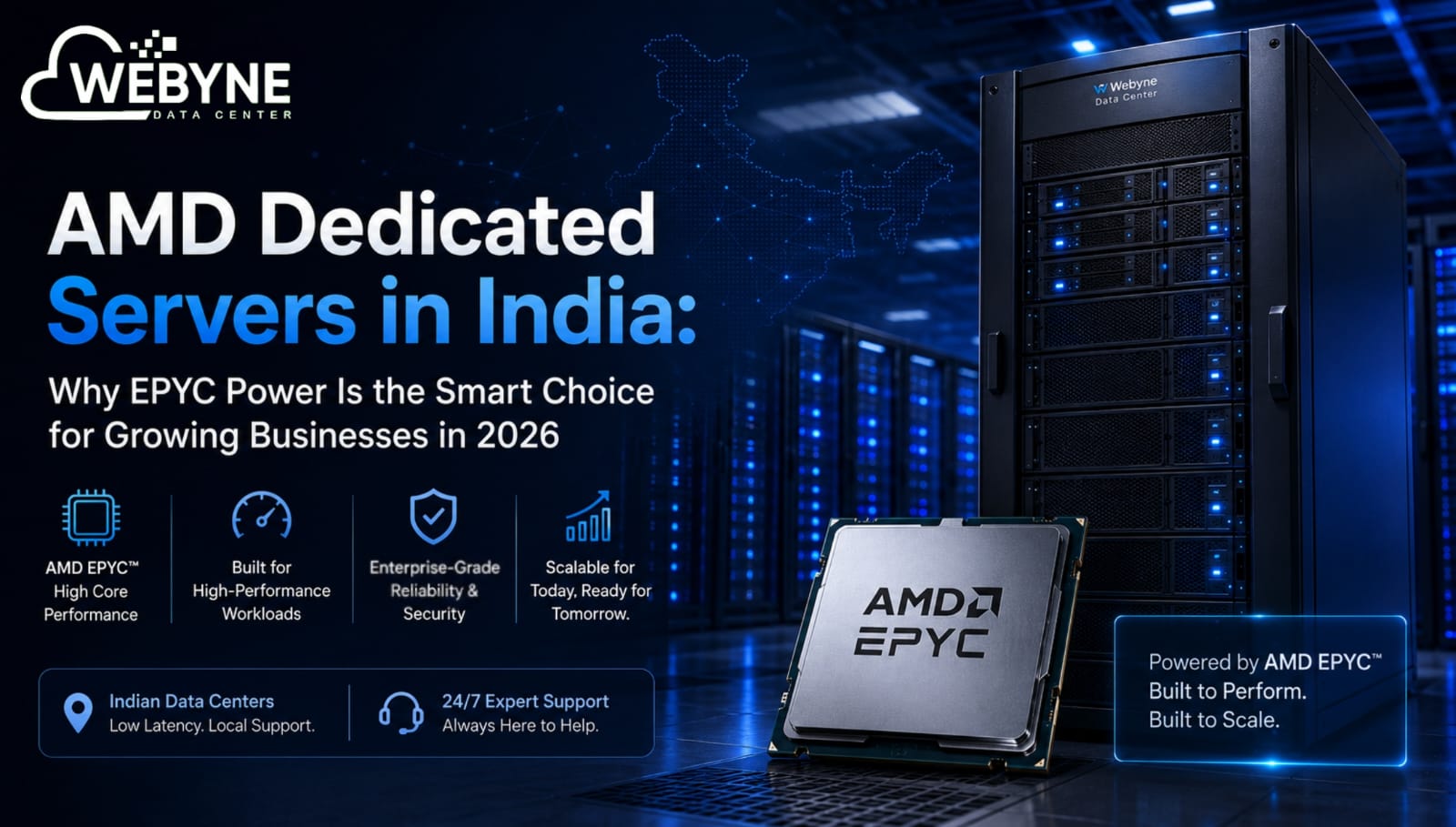
AMD dedicated servers specifically use AMD's EPYC (and in some cases Ryzen) processors, known for high core counts, strong multi-threaded performance, and excellent performance-per-rupee compared to many Intel equivalents in the same price bracket.
Why Businesses Are Choosing AMD EPYC Over Traditional Options
1. Serious Multi-Core Performance AMD EPYC processors are built for parallel workloads — think database queries, video rendering, ERP systems, or high-concurrency web apps. With core counts ranging from 8C/16T entry-level configurations up to 96C/192T dual-processor setups, EPYC servers scale to match genuinely demanding production environments.
2. Full Root Access and Customization A dedicated server gives you complete control over the OS, software stack, and configuration — something impossible on shared hosting. Whether you're running a custom LAMP stack, Docker containers, or a Windows Server environment, you configure it exactly how your application needs it.
3. Built-In Security Since no other tenant shares your hardware, the attack surface is naturally smaller. Add firewalls, DDoS protection, and regular security patching on top, and you get an environment suited for sensitive data — financial platforms, healthcare systems, and e-commerce checkouts included.
4. Room to Scale Growth shouldn't mean migration headaches. AMD dedicated server plans typically scale from budget-friendly 8-core configurations to 96-core, 512GB RAM enterprise-grade machines, so you can upgrade resources as demand grows rather than re-architecting your infrastructure from scratch.
5. Better Price-to-Performance EPYC processors are known for delivering strong core-per-rupee value, which is why plans starting around ₹7,999/month can already offer 8 cores, 16 threads, and 64GB RAM — pricing that's hard to match with equivalent Intel dedicated servers.
Who Actually Needs a Dedicated Server?
● High-traffic websites and e-commerce stores that can't afford slowdowns during sales or peak hours
● SaaS and web applications with unpredictable, high-concurrency traffic
● Agencies and developers hosting multiple client sites who need isolation and control
● Enterprises with compliance, auditing, or data residency requirements
● Gaming and streaming platforms that need low latency and consistent uptime
If your current hosting setup is throttling, or you're seeing performance dips whenever traffic increases, that's usually the signal it's time to move to dedicated.
Entry-Level vs. High-Rise EPYC Configurations
AMD dedicated server plans generally fall into two categories:
● Standard EPYC servers (7000-series like EPYC 7252, 7313P, 7452, 7543) — solid all-rounders for websites, applications, and small-to-mid enterprise workloads, with configurations from 8 cores/64GB RAM up to 96 cores/512GB RAM.
● High-rise / next-gen EPYC servers (9004-series like EPYC 9124 with DDR5 RAM and U.3 NVMe storage) — built for latency-sensitive, high-throughput workloads that need the newest silicon and faster memory bandwidth.
Choosing between them usually comes down to whether your workload is CPU-bound (favor higher core/thread counts) or needs faster memory and storage I/O (favor DDR5 + NVMe high-rise configs).
What to Check Before You Buy
- SLA and uptime guarantee — look for at least 99.95% SLA
- Support availability — 24/7 support matters more than it seems until something breaks at 2 AM
- Bandwidth and network speed — 1 Gbps is standard; make sure it matches your traffic expectations
- Control panel options — cPanel or Plesk saves significant admin overhead
- Backup and disaster recovery — automated backups aren't optional for production workloads
- Data center location — closer data centers mean lower latency for your Indian user base
Final Thoughts
An AMD dedicated server isn't just about raw specs — it's about giving your business room to grow without infrastructure becoming the bottleneck. With core counts scaling from 8 to 96+, DDR5-backed high-rise configurations for demanding workloads, and dedicated resources that eliminate the unpredictability of shared environments, AMD-powered hosting has become the practical choice for Indian businesses serious about performance and uptime.
Whether you're a startup outgrowing shared hosting, an agency managing multiple client sites, or an enterprise with compliance needs, there's an AMD EPYC configuration built for your workload — starting at ₹7,999/month and scaling up to enterprise-grade dual-processor setups.
Ready to move to dedicated hardware? Explore Webyne's AMD Dedicated Server plans and talk to our team about the right configuration for your infrastructure.